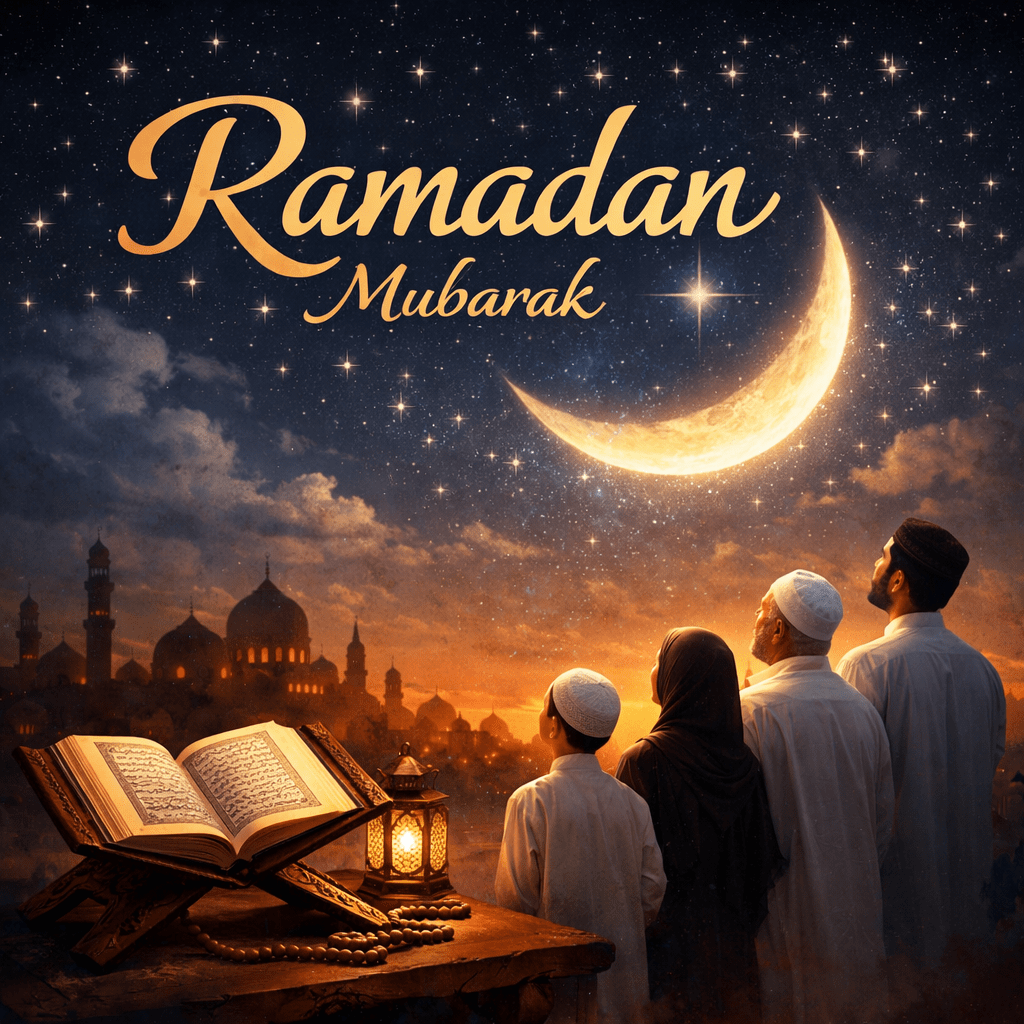
Every year, as Ramadan approaches, Muslims around the world find themselves returning to the same familiar debate: Has the moon been sighted? And if not, whose calculation, sighting, or announcement should we follow?
What should be a moment of collective spiritual anticipation too often becomes an annual fallout.
This year, astronomers have been clear: the new moon cannot be seen until Wednesday evening. Scientifically, this means Ramadan should begin on Thursday. And yet, the question remains: will Saudi Arabia announce the start on Wednesday regardless, as has happened in previous years? History suggests that this is not unlikely. Time and again, official declarations have contradicted established astronomical data, leaving many confused and frustrated.
In Britain, this creates real division.
Some Muslims follow Saudi announcements unquestioningly.
Some follow their country of birth.
Some follow the mosque committees.
Some follow scientific calculations.
The result is fragmentation. Families begin fasting on different days. Mosques announce different start days. Communities pray Eid on separate mornings. Even within the same household, people sometimes observe Ramadan and celebrate Eid on different days.
The very month that is meant to unite us spiritually ends up highlighting our disunity.
And this raises an important question: why do we accept this every year?
Why, in the twenty-first century, with access to advanced astronomy, global communication, and shared knowledge, do we still act as though we are unable to organise ourselves? Why do we not, as a global ummah, develop a reliable, scientifically grounded Islamic calendar that gives clarity, consistency and unity?
Following science is not “bid‘ah”.
Islam does not reject knowledge. On the contrary, it commands it. The very first revelation was “Read”. Our tradition is filled with scholars who studied mathematics, astronomy, medicine and philosophy. Muslim civilisation once led the world in scientific inquiry. Using accurate calculations to determine lunar months is not a betrayal of faith. It is an extension of it.
Sighting the moon in the past was a practical necessity. It was the best available method. Today, we have better tools. To ignore them is not piety. It is unnecessary stubbornness.
The Prophet ﷺ instructed his companions according to what was possible in their time. Our responsibility is to use what is possible in ours.
What we are witnessing is not a religious problem. It is a leadership problem. It is an organisational problem. And it is a failure of collective courage to move forward.
Meanwhile, the wider context is deeply meaningful.
This year, Ramadan coincides with the Christian festival of Lent (18th February – 5th April) and the Jewish festival of Purim (2-3 March). Three Abrahamic traditions, all centred on reflection, self-restraint, repentance, generosity, and remembrance, unfolding at the same time. This is not insignificant. It reminds us that our faiths are connected, that our moral foundations overlap and that spiritual discipline is a shared human experience.
At a time when religion is often portrayed as divisive, here is a moment of quiet alignment. Muslims fasting, Christians reflecting, Jews commemorating survival and faith. Different rituals, shared values.
And yet, while others manage to observe their seasons with consistency, Muslims continue to argue over dates.
It does not have to be this way.
There will come a time, in the not-too-distant future, when Ramadan and Eid fall close to Christmas. When fasting, feasting, and festive lights overlap. When public life must accommodate multiple sacred calendars simultaneously. That moment will demand maturity, cooperation and clarity from all faith communities.
If we cannot even agree among ourselves when our holiest month begins, how can we engage confidently and constructively with wider society?
Unity does not mean uniformity of opinion. But it does mean shared purpose.
We can respect scholarly diversity while agreeing on practical systems. We can honour tradition while embracing knowledge. We can preserve spirituality without clinging to confusion.
Most importantly, we can choose not to let technical disputes overshadow the essence of Ramadan: humility, mercy, justice, gratitude, and transformation.
Whether we begin on Wednesday, Thursday, or Friday, the fast remains between us and God. The prayers still rise. The Qur’an is still recited. The poor still deserve our care. The soul still seeks purification.
But imagine how powerful it would be if we experienced this month together.
One beginning. One ending. One collective celebration.
Not as disparate communities, but as one worldwide ummah.
And as we share this sacred season alongside our Christian and Jewish neighbours, may it remind us that faith, at its best, is a bridge not a barrier. A source of compassion, not conflict. A call to conscience, not chaos.
May Ramadan, Lent, and Purim inspire us all to be more thoughtful, more generous and more united. Within our own traditions and across them.
And may we find the wisdom to move beyond annual arguments, towards lasting harmony.
Ramadan Mubarak!
 Soulful Spaces