Ramadan, Moonsighting and the Annual Divide

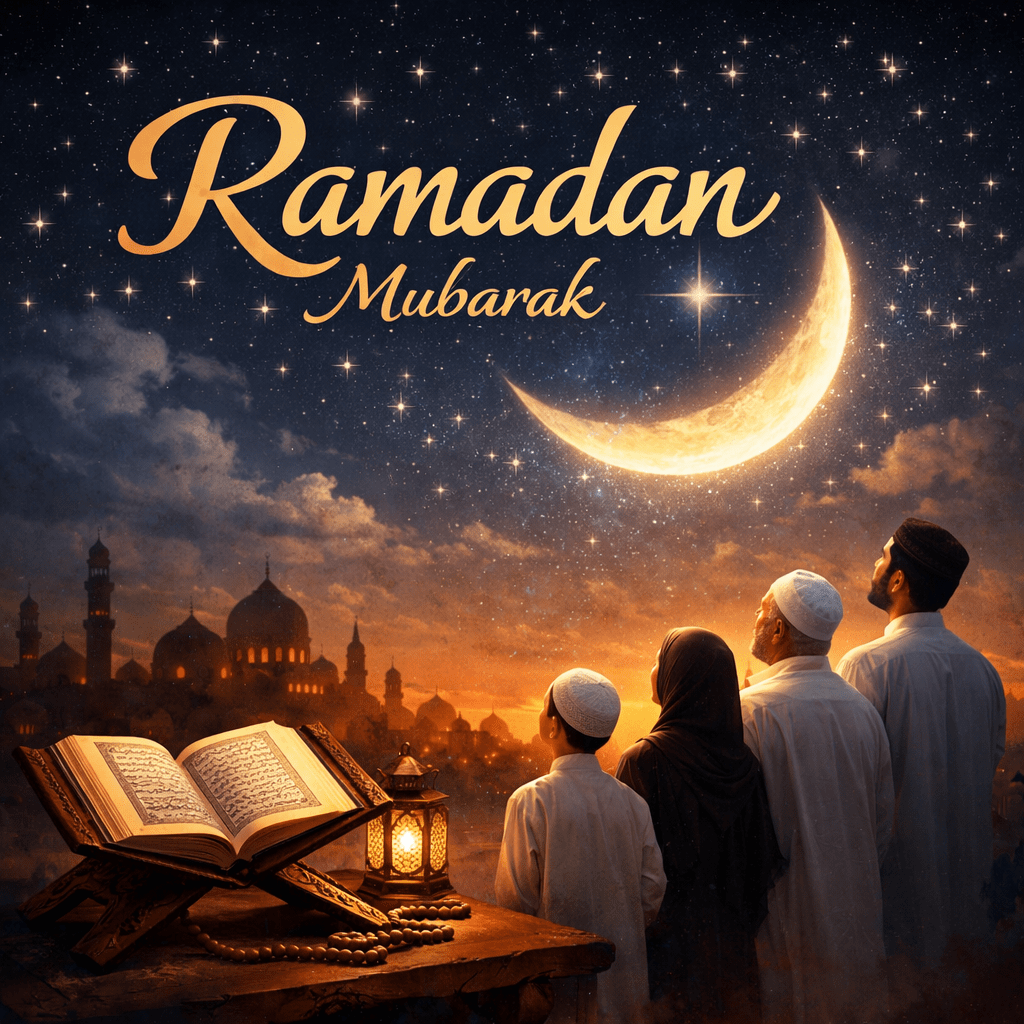
Every year, as Ramadan approaches, Muslims around the world find themselves returning to the same familiar debate: Has the moon been sighted? And if not, whose calculation, sighting, or announcement should we follow?

What should be a moment of collective spiritual anticipation too often becomes an annual fallout.

This year, astronomers have been clear: the new moon cannot be seen until Wednesday evening. Scientifically, this means Ramadan should begin on Thursday. And yet, the question remains: will Saudi Arabia announce the start on Wednesday regardless, as has happened in previous years? History suggests that this is not unlikely. Time and again, official declarations have contradicted established astronomical data, leaving many confused and frustrated.

In Britain, this creates real division.

Some Muslims follow Saudi announcements unquestioningly.

Some follow their country of birth.

Some follow the mosque committees.

Some follow scientific calculations.

The result is fragmentation. Families begin fasting on different days. Mosques announce different start days. Communities pray Eid on separate mornings. Even within the same household, people sometimes observe Ramadan and celebrate Eid on different days.

The very month that is meant to unite us spiritually ends up highlighting our disunity.

And this raises an important question: why do we accept this every year?

Why, in the twenty-first century, with access to advanced astronomy, global communication, and shared knowledge, do we still act as though we are unable to organise ourselves? Why do we not, as a global ummah, develop a reliable, scientifically grounded Islamic calendar that gives clarity, consistency and unity?

Following science is not “bid‘ah”.

Islam does not reject knowledge. On the contrary, it commands it. The very first revelation was “Read”. Our tradition is filled with scholars who studied mathematics, astronomy, medicine and philosophy. Muslim civilisation once led the world in scientific inquiry. Using accurate calculations to determine lunar months is not a betrayal of faith. It is an extension of it.

Sighting the moon in the past was a practical necessity. It was the best available method. Today, we have better tools. To ignore them is not piety. It is unnecessary stubbornness.

The Prophet ﷺ instructed his companions according to what was possible in their time. Our responsibility is to use what is possible in ours.

What we are witnessing is not a religious problem. It is a leadership problem. It is an organisational problem. And it is a failure of collective courage to move forward.

Meanwhile, the wider context is deeply meaningful.

This year, Ramadan coincides with the Christian festival of Lent (18th February – 5th April) and the Jewish festival of Purim (2-3 March). Three Abrahamic traditions, all centred on reflection, self-restraint, repentance, generosity, and remembrance, unfolding at the same time. This is not insignificant. It reminds us that our faiths are connected, that our moral foundations overlap and that spiritual discipline is a shared human experience.

At a time when religion is often portrayed as divisive, here is a moment of quiet alignment. Muslims fasting, Christians reflecting, Jews commemorating survival and faith. Different rituals, shared values.

And yet, while others manage to observe their seasons with consistency, Muslims continue to argue over dates.

It does not have to be this way.

There will come a time, in the not-too-distant future, when Ramadan and Eid fall close to Christmas. When fasting, feasting, and festive lights overlap. When public life must accommodate multiple sacred calendars simultaneously. That moment will demand maturity, cooperation and clarity from all faith communities.

If we cannot even agree among ourselves when our holiest month begins, how can we engage confidently and constructively with wider society?

Unity does not mean uniformity of opinion. But it does mean shared purpose.

We can respect scholarly diversity while agreeing on practical systems. We can honour tradition while embracing knowledge. We can preserve spirituality without clinging to confusion.

Most importantly, we can choose not to let technical disputes overshadow the essence of Ramadan: humility, mercy, justice, gratitude, and transformation.

Whether we begin on Wednesday, Thursday, or Friday, the fast remains between us and God. The prayers still rise. The Qur’an is still recited. The poor still deserve our care. The soul still seeks purification.

But imagine how powerful it would be if we experienced this month together.

One beginning. One ending. One collective celebration.

Not as disparate communities, but as one worldwide ummah.

And as we share this sacred season alongside our Christian and Jewish neighbours, may it remind us that faith, at its best, is a bridge not a barrier. A source of compassion, not conflict. A call to conscience, not chaos.

May Ramadan, Lent, and Purim inspire us all to be more thoughtful, more generous and more united. Within our own traditions and across them.

And may we find the wisdom to move beyond annual arguments, towards lasting harmony.

Ramadan Mubarak!

Misogyny, Power and Moral Failure

There has been increasing public discussion in the UK, in recent years about misogyny. What it is, how it manifests and why it continues to shape women’s lives despite decades of progress on equality. Yet the term is still often misunderstood or deliberately minimised.

Misogyny is not simply a dislike of women. It is a system of attitudes and behaviours that devalues women, polices their presence and seeks to control or punish them when they step outside roles deemed acceptable. It shows up in overt hostility and just as often in quieter more corrosive forms such as silencing, undermining, exclusion and character assassination.

And misogyny is not an abstract concept.

It is lived, felt and experienced daily by women in public spaces, workplaces and too often within communities that claim moral or religious authority. It shapes who is heard, who is believed and who is allowed to lead.

In some cultures and community settings misogyny remains deeply entrenched. Women are still treated as secondary, expected to serve rather than lead, to organise rather than decide. Their competence is tolerated only up to the point where it threatens established hierarchies. When women are articulate, confident and capable some men respond not with growth or self-reflection, but with fear.

That fear often manifests as control.

False narratives are created. Motives are questioned. Reputations are attacked sometimes subtly sometimes openly. Slander becomes a tool to put women back in their place particularly when they refuse to be small or silent. Allegations are made without evidence or proof not in pursuit of truth but to preserve male dominance and authority.

This pattern is especially visible in so called community leadership spaces. Women are welcomed to make the teas organise events and tidy up afterwards but leadership, decision-making and public authority remain stubbornly male. The moment a woman challenges that imbalance, the atmosphere changes.

Such behaviour is not only inequitable, it robs communities of talent, insight and balanced leadership and deprives young girls of powerful, visible role models signalling that women’s excellence is unwelcome or threatening.

A community that sidelines women does not preserve tradition. It weakens itself.

Living in a modern democratic society requires honesty. Misogyny is not strength, it is insecurity. And slander is not leadership, it is moral failure. Men who feel threatened by capable women often resort to character assassination, because it is easier than accountability or self examination.

Real leadership demands confidence without cruelty, authority without fear and integrity without ego.

For faith communities, particularly Muslim ones, there is no theological excuse for misogyny.

The Prophet Muhammad ﷺ , often described as the best of men, treated women with dignity, respect and trust. He consulted women, valued their intellect and affirmed their moral and social worth. He taught that the measure of a man’s character lies in how he treats women.

Islam also takes an uncompromising stance on slander.

The Qur’an condemns false accusation as a grave sin particularly when it destroys a person’s honour. These teachings were revealed following the public slander of a woman and they establish a clear moral principle that accusation without proof is injustice. To spread suspicion, rumours or unverified claims is not righteousness. It is corruption.

To malign a woman’s reputation in order to protect male authority or fragile ego is not piety. It is a betrayal of faith.

Islam granted women rights to dignity, property, inheritance and voice at a time when many societies treated them as chattel. Any culture that silences women, excludes them from leadership, or targets them through character assassination, is not upholding religion. It is contradicting it.

Cultural change requires courage. Communities must stop excusing behaviour they would never tolerate if directed at men. Leadership must be measured by integrity not control. And men must learn that equality is not a threat. It is a responsibility.

Respect for women is not a modern concession. It is a moral obligation.

Until that truth is lived rather than spoken misogyny will continue to hide behind culture, silence and misplaced authority. And that is something no ethical or faith based community should accept.

Reflections from 2025: Defending Truth in an Age Where Distortion Is Rewarded

And so another year comes to a close. 2025 has exposed how misinformation is no longer accidental or fringe but strategic, profitable and deliberately provocative. Falsehood was not merely tolerated but monetised, amplified by those with vast reach who blurred the line between opinion and fact, scepticism and conspiracy. Confidence, repetition and volume increasingly replaced evidence while complexity was dismissed as weakness or elitism.

What became especially clear was how distortion thrives not only in public discourse but within institutions and communities that should know better. Allegations circulated without evidence, narratives repeated until they acquired the appearance of truth and reputations eroded quietly rather than challenged openly. When falsehood is allowed to stand uncorrected harm does not need to be dramatic to be devastating.

The responsibility now extends beyond media literacy to moral discernment. We must ask who benefits from a narrative, whose humanity is diminished by it and what harm is normalised when distortion goes unchallenged. When truth is treated as optional and cruelty reframed as honesty neutrality becomes complicity.

Democracy needs participation not comfort or loyalty

My own political journey came to an abrupt end in 2022 leaving me politically homeless. That experience reinforced a difficult but vital truth. Politics is not about tribal loyalty or defending a home at all costs.

More than ever 2025 showed that we must remain politically engaged and willing to speak out against injustice especially when wrongdoing occurs within spaces movements or institutions we once trusted. Silence in the face of wrong for the sake of belonging reputation or convenience is itself a political act and one with consequences.

Actively resist the normalisation of hate

2025 demonstrated with unsettling clarity that online rhetoric does not remain online. Language that begins as just opinion or asking questions is legitimised through repetition platforming and algorithmic reward before migrating into streets, schools and workplaces.

What made this especially dangerous was the veneer of respectability. Hostility was reframed as courage. Accusation as concern. Slander as accountability. In such climates those who challenge falsehood are cast as disruptive while those who spread it claim moral ground. History shows that harm rarely announces itself as violence. It arrives first as language that trains people to look away.

Treat faith literacy as a safeguarding necessity

Public debate in 2025 repeatedly revealed how ignorance about belief fuels fear, poor policy and safeguarding failures. Faith was misrepresented, weaponised or reduced to caricature by those with little understanding but significant platforms.

Equally troubling was the misuse of religious identity itself. The assumption that appearing outwardly devout equates to ethical conduct. Faith is not proven by performance but by integrity. Communities are safeguarded not by appearances but by truthfulness, accountability and the courage to confront wrongdoing even when it is uncomfortable.

The Qur’an warns explicitly against the casual spread of unverified claims:

“When you received it with your tongues and said with your mouths what you had no knowledge of and thought it was trivial while in the sight of God it was grave.”

Qur’an 24:15

Misunderstanding does not remain abstract. It causes real harm.

Demand ethical leadership not performative strength

2025 revealed how easily leadership can slide into spectacle. Volume was mistaken for authority, dominance for decisiveness and disruption for courage. Cruelty was reframed as authenticity and harm excused as bluntness.

This pattern is not limited to politics. It appears wherever power is unchecked and challenge is treated as disloyalty. Ethical leadership is not about commanding platforms or silencing critics. It is about restraint truthfulness and being answerable for consequences especially when false allegations or institutional bullying are allowed to take root.

Recognise that safeguarding failures are cumulative not sudden

Safeguarding failures rarely stem from a single catastrophic decision. They emerge from cultures of fear, reputational anxiety and reluctance to act without absolute certainty. Warning signs are minimised. Concerns reframed as inconvenience. Those who speak up labelled difficult.

When institutions prioritise self-protection over truth harm is displaced rather than prevented. Whether in schools, charities or public systems the result is the same. People are left exposed while procedures are treated as protection.

Redefine resilience as moral courage not endurance

2025 made clear that resilience is not the ability to absorb injustice quietly. Being expected to tolerate falsehood, character assassination or intimidation in the name of harmony leads not to strength but to moral injury.

True resilience is grounded in values faith and solidarity and in the courage to name harm early before distortion hardens into practice and practice into policy.

Measure legacy by who is protected not who is amplified

In a year marked by displacement poverty and widening inequality 2025 sharpened the question of legacy. Influence was too often used to dominate debate rather than protect the vulnerable.

Legacy is not about platforms, titles or appearances of virtue. It is about whether truth was defended whether the vulnerable were believed and whether power was used to protect rather than to silence.

Turn hope into enforceable protection

The introduction of a legal framework addressing violence against women and girls marked a significant shift in 2025. It acknowledged what survivors have long known. Harm is systemic not exceptional.

But hope cannot stop at legislation. Protection must be real, trusted and enforced especially for those whose voices have historically been dismissed doubted or maligned.

Refuse neutrality in the face of suffering

2025 will be remembered as a year when suffering could not plausibly be denied. Mass death, displacement and deprivation unfolded in real time both globally and at home.

The responsibility of this generation is to refuse hierarchies of human worth and to reject the quieter harms that occur when lies are allowed to stand because challenge feels inconvenient. Neutrality in such moments is not balance. It is abandonment.

Looking to 2026

May 2026 be a year of freedom, of hope and of justice restored. May those who have been slandered and misrepresented find truth spoken on their behalf and dignity returned to their names. May the oppressed be believed rather than doubted and protected rather than managed. May voices long ignored be heard without distortion and without fear. May the hungry be fed with urgency not charity alone. May the injured find care that heals rather than delays. May the sick be met with compassion not suspicion. And may those who wield power remember that accountability is not weakness but moral strength. If truth is defended early and courage exercised collectively then 2026 can be not only a year after harm but a year beyond it.

Faith, Festivities and the Fiction of a Christmas ‘Threat’

Every year, without fail, the same tired myth drags itself out of hibernation, fuelled by headlines like “Outrage as council ‘rebrands’ Christmas to be more inclusive” and “Fury as Christmas events ‘scrapped’ to avoid offending Muslims”.

Never mind that these stories are debunked within hours. Apparently some people genuinely think Muslims spend December plotting the downfall of baubles.

Right on cue, certain commentators, right wing tabloids and so called influencers (the ones who think cultural literacy is a brand of toothpaste) leap into action. Because why let facts ruin a perfectly good culture war fantasy?

So let’s set the record straight.

Again.

1. Muslims do not hate Christmas.

We don’t mind the lights, the music, the markets, the festive chaos or even George in the gym who starts playing Christmas songs as soon as Halloween is out of the way.

We actually enjoy the warmth, the friendliness and the kindness the season brings even from people who earlier fought someone for a parking space.

2. Muslims absolutely do not hate Jesus.

Far from it. Jesus (upon him be peace) known in Arabic as Isa, is one of the most revered Prophets in Islam. His birth, his miracles and his message are spoken of with deep respect in the Qur’an. Muslims believe he was born miraculously to Mary, who is honoured as one of the most pious and exalted women in history. In fact Mary has an entire chapter of the Qur’an named after her, something not found even in the Bible.

Islam teaches that Jesus was a sign of God’s mercy, a bringer of compassion and justice, and a Prophet whose life is held in profound esteem. So the idea that Muslims somehow dislike Christ could not be further from the truth.

So no we are not plotting to erase him from the calendar.

3. Opting out of commercial madness does not mean hating Christmas.

Some Muslims join in fully. Some don’t.

Some put up trees, exchange gifts and enjoy halal turkey and alcohol free Christmas pudding.

Some prefer something quieter and more reflective.

And in my case I have a grandson born on Christmas Day which means the 25th is less about some imaginary war on Christmas and more about Noahmas. Cake, wrapping paper explosions, excited squeals and a very happy little boy.

None of this means we secretly want to ban:

* Christmas trees

* Christmas lights

* Carol singers

* Nativity plays

* School concerts

Or the neighbour who turns their house into Blackpool Illuminations on a budget.

So why does this myth keep returning?

Because it serves a purpose. Some people need a villain, someone to blame, fear or shout about. Muslims become that target.

But what makes it even more persistent is how certain groups wrap culture, faith and national identity together and then claim any difference is a threat.

Look at the rallies planned by certain divisive individuals, where chants about Christian heritage, defending Britain and reclaiming traditions are mixed with anti Muslim sentiment. The message is clear. Britain must be protected from an imagined enemy, and Muslims are cast as that enemy each winter when the Christmas myths begin again.

By repeating the idea that Muslims are hostile to Christmas these narratives stoke a sense of siege. They create the false impression that our culture is under attack, that Christmas is being cancelled and that someone must be blamed. It is a powerful and convenient distraction.

It is far easier to shout that Muslims are cancelling Christmas than to engage with real issues affecting our country. Loneliness, poverty, people struggling through winter or the fact that commercialisation has smothered much of the season’s spiritual heart. Families up and down the country are also battling the pressure to keep up with the Joneses so their children don’t feel left out. The latest gadgets, computer games, phones, trainers and the endless stream of must-have gifts create a mountain of expectation that many simply cannot afford. For countless parents the real stress of Christmas is not the lights or the carols but the fear that their children will notice what they cannot provide.

Instead we get distraction and division. A ready made wedge.

And it works until you actually speak to Muslims and realise we are simply part of the same festive swirl, sometimes joining in, sometimes not, often juggling our own family celebrations with everyone else’s.

The truth?

Most of us are just trying to get through December. End of term chaos, Christmas nativities and school fairs, winter colds, work deadlines, Noahmas planning and of course the most pressing question of all:

Where on earth am I putting my Christmas tree this year?

Lest We Forget: Reflections on Remembrance Day

Today is Armistice Day. Eighty years ago, the guns fell silent at the 11th hour of the 11th day of the 11th month. Across the country, people will pause in schools, offices, shops and streets to remember all those who gave their lives so that we might live free from tyranny.

I was honoured, on Remembrance Sunday, to lay a wreath as part of a local Service of Remembrance in my capacity as a Deputy Lieutenant of Staffordshire, representing the Lord-Lieutenant and through her, His Majesty the King. It is a privilege to serve in a role that supports civic life, represents the Crown in Staffordshire and celebrates the people and communities that make our nation thrive.

Each year, as the nation falls silent, we come together to honour those who gave their lives in the service of others. We do this not out of ritual, but out of duty. Remembrance is not simply about looking back, it is about safeguarding the lessons of history for the generations that follow. The freedom, democracy and peace we enjoy today were bought at a cost beyond measure. It is a debt that can never be repaid, but must never be forgotten.

As I stood among veterans, cadets, civic leaders and local residents, the words “Lest We Forget” echoed powerfully. Around me were faces of every background, people whose roots trace across continents, yet who share the same pride in calling Britain home. The richness and diversity that define our country today exist because of the sacrifices of those who fought and died to defend freedom from tyranny and fascism.

And we must never forget that among those who served were men and women of many nations and faiths. Muslims, Sikhs, Hindus, Jews, Christians and others, who fought side by side under the British flag. More than 2.5 million soldiers from undivided India served during the World Wars, many never returning home. Their courage and sacrifice helped shape the Britain we know today and the diversity of this island is, in many ways, their living legacy.

It is easy to think of war as distant history, sepia photographs and fading medals. But the values for which those brave men and women stood remain as vital now as they were then. The fight against oppression, prejudice and injustice continues in different forms across the world. Remembering them is also about recognising our responsibility to challenge hatred wherever it arises and to uphold the dignity of all people.

As the years pass, the number of surviving veterans from the great wars grows ever smaller. Their voices, once so many, are now few and far between. Schools do their best to teach remembrance, and I have great admiration for teachers who bring these stories to life for young minds. But collective memory needs more than education, it needs community. It needs us all to come together, to bear witness, and to pass on the stories of courage and loss that shaped who we are.

For me, a middle-aged, Pakistan-born British Muslim, wearing the badge of a Deputy Lieutenant on Remembrance Sunday is not only a symbol of service, it is a statement of belonging. It reflects the shared values that bind us as citizens of this country, regardless of faith or heritage. It is a reminder that the freedoms we cherish are built upon the sacrifices of those who came before us and that our duty now is to honour their legacy through unity, respect and compassion.

So when the bugle sounds and the silence falls, I bow my head with gratitude and with hope.

Because remembrance is not just about the past.

It is a promise to the future.

Lest we forget

A Risky Invitation: Why Israel’s Move to Host Tommy Robinson Is Especially Troubling Right Now

Recent events in the UK, most notably the attack on a synagogue in Manchester, have created a charged and fragile atmosphere. It is therefore all the more reckless for Israel to extend an olive branch to Tommy Robinson (real name Stephen Yaxley-Lennon), a man with a long history of bigotry, criminality, and provocation. That this invitation comes now is no coincidence. It is a signal, a declaration of whose battles Israel wants to fight, and with whom. This decision is deeply inappropriate and should concern anyone who values justice, pluralism, and alliances grounded in principle rather than convenience.

On 2 October 2025, gun and knife violence struck the Heaton Park Hebrew Congregation in Manchester, killing two worshippers and injuring others. The attacker, Jihad al-Shamie, was shot dead by police and is believed to have been motivated by extremist Islamist ideology. This brutal assault on a synagogue during Yom Kippur horrified the nation, deepening fears within Jewish communities about safety and the resurgence of antisemitism.

But this attack cannot be viewed in isolation. Only days earlier, a mosque in Brighton was subjected to an arson attack, an incident that barely registered in the mainstream press and, tellingly, was not described as terrorism. Both events expose a deeply troubling reality: faith communities across Britain are being targeted, their sacred spaces turned into battlegrounds of hate. Whether Jewish or Muslim, no one should ever have to fear gathering to pray. The UK is nursing wounds of grief, mistrust, and vigilance. At such a moment, when communities are desperate for calm leadership and compassion, Israel’s decision appears not only tone-deaf but dangerously divisive.

In times of communal trauma, every gesture matters. Political leaders, faith institutions, and states alike must tread carefully, recognising that their choices send powerful signals about who is seen as an ally and who is cast as a threat. That is why it is heartening that organisations such as the Jewish Leadership Council have spoken out against this invitation. Communities already living with fear will interpret gestures like this not as acts of solidarity but as provocations. Inviting a figure like Yaxley-Lennon at this moment is far from neutral. It is loaded with meaning, and none of it benign.

Yaxley-Lennon’s record speaks for itself. He has multiple criminal convictions, including for contempt of court and fraud. He was imprisoned for his actions and has built a public persona on anti-Muslim hostility, aggression, and inflammatory rhetoric. As founder of the English Defence League, he normalised extremist discourse under the false banner of “protecting Britain from Islamism.” His rallies frequently descended into violence and arrests. He is not a moderate, not a bridge-builder, and certainly not a voice for peace.

By publicly associating with Yaxley-Lennon, Israel elevates a man widely recognised as a purveyor of hate. Even within Jewish circles and among Israel’s traditional allies, the move has been condemned. As LBC reported, “Britain’s Jewish leaders slam Israel over ‘thug’ Yaxley-Lennon invite.” Israel’s Diaspora Minister has defended the decision, saying it seeks to “strengthen bonds with allies who refuse to be silent.” But that language carries dangerous implications. It legitimises Yaxley-Lennon’s worldview and situates Israel alongside hard-right, confrontational voices. In doing so, it entangles Israel in domestic British divisions and undermines its own moral standing.

Israel often portrays itself as a democracy under threat, a nation that champions tolerance and resists extremism. Yet by embracing someone whose rhetoric has inspired division and hostility, it weakens its credibility. The faces a state chooses to amplify reveal where its loyalties lie. In this case, the message is unmistakable.

While the Manchester synagogue attack has rightly dominated headlines, it must not obscure the broader pattern of religiously motivated hatred now spreading through Britain. The Brighton mosque arson, largely ignored by mainstream outlets, is a chilling reminder that Islamophobia continues to scar our social fabric. To extend an invitation to Yaxley-Lennon in such a climate is to ignore the pain of Muslim communities already demonised and attacked. It sends the message that some victims deserve empathy and others do not, that antisemitic terror is “terrorism,” while anti-Muslim violence is merely “arson” or “extremism.” This double standard is corrosive. It breeds alienation, fuels resentment, and reinforces the idea that certain lives are more worthy of protection than others.

Israel, which claims moral authority in its fight against hatred, should be especially careful not to mirror such hierarchies. Instead of platforming an agitator, it could have extended genuine solidarity to British Jews through diplomacy, interfaith dialogue, and support for community safety. It could have encouraged unity between faiths by amplifying the voices of British Jewish and Muslim leaders who work daily to bridge divides. It could have used its influence to call for compassion and calm rather than importing polarisation from one conflict into another.

The alternative was clear: to stand with communities, not ideologues, to promote healing, not hostility. Yet Israel has chosen the opposite, and in doing so, it risks alienating the very people it claims to support. Muslim communities in the UK, already under pressure and often unfairly linked to global conflicts, may feel even more marginalised by Israel’s actions. Within the Jewish community too, there will be unease and division, between those who see Yaxley-Lennon’s support as validation and those who are appalled that their safety is being used as a political pawn.

Inviting Yaxley-Lennon under the guise of solidarity is not diplomacy, it is a political statement. It says far more about who Israel considers its friends and enemies than about any genuine commitment to combating hate. In times of pain and violence, leaders are tested not by whom they can provoke, but by whom they can unite.

If Israel truly wishes to support British Jewry, it should extend hands of peace, not applaud those who thrive on division. Real courage lies in championing voices that heal, not amplifying those that harm.

Condemnation of the Attack on Manchester Synagogue

The attack on the Jewish community in Manchester, targeting a synagogue on one of its holiest days, must be condemned without hesitation. To strike at a place of worship is an assault not only on one faith, but on all who value peace, dignity and the right to practise religion freely.

Jews and Muslims share much in history, in values, and in our deep connection to worship, family and community. At times like this, it is vital we remember that what unites us far outweighs what others may try to use to divide us. An attack on a synagogue is an attack on every mosque, every church, every gurdwara, and every sacred space.

The Prophet Muhammad (peace be upon him) taught us: “Whoever harms a person under covenant (a non-Muslim living in peace among Muslims), I will be his adversary on the Day of Judgement.” This powerful Hadith reminds us that safeguarding the rights, safety, and dignity of others – regardless of their faith – is a sacred duty.

Whatever tensions and conflicts exist in the world, they must never be allowed to spill over into hatred or violence on the streets of Britain. Here, every person of every faith should be able to walk into their place of worship free from fear.

This attack was not just on one community – it was on all of us. The only answer must be solidarity, compassion, and a shared commitment to protect one another.

Not Our Culture, Not Our Martyrs: Britain Doesn’t Need Valhalla Politics

Before his killing, I had never even heard of Charlie Kirk. Having stepped away from X/Twitter, I had no real exposure to the American right-wing influencer bubble. Yet, in the last 48 hours, our UK media has been saturated with his name, his photograph, his story. Rolling coverage, live updates, glowing tributes – as if a man most Britons had never heard of until yesterday is suddenly of historic importance.


And it begs the question: why this level of obsession?

In Britain, we know the devastation of political assassinations. We remember Jo Cox, brutally murdered by a far-right extremist in 2016. We remember Sir David Amess, stabbed to death in 2021. Both were sitting MPs, elected representatives serving their communities. Their deaths shook our nation. Yet our media reported those killings with restraint and dignity. Their funerals were sombre, their legacies remembered in context – not idolised, not mythologised, not immortalised into warrior legends.

In stark contrast, the coverage of Charlie Kirk has taken on an almost mythic tone. He is being cast not just as a victim of violence, but as a martyr, a heroic defender of Western civilisation. Even the FBI director, Kash Patel, referred to him as a “brother” and signed off with the words, “see you in Valhalla.” The choice of language is extraordinary: Valhalla evokes Norse warrior mythology, a world of pillage, conquest, and violent glory.

For a public servant, heading a law enforcement agency, to draw on that imagery is jarring. It blurs the line between sober justice and the aesthetics of battle and martyrdom. It is not Christian, not civic, and not measured. Instead, it romanticises Kirk’s death, elevating him into the realm of myth and legend, far removed from the much harsher reality of who he was and what he stood for.

Let’s be honest: Charlie Kirk was not some neutral “family man.” His public career was built on misogynistic, racist, and homophobic views. He mocked the deaths of Palestinians and condoned the brutality in Gaza. He pushed an aggressive pro-gun agenda in a country already bleeding from gun violence. Yet now, headlines describe him as a family man, a patriot, a visionary – erasing the uglier truths of his record.

This sanitisation matters. When our media joins in the idolisation of figures like Kirk, it imports America’s culture wars into our public space and tells us which lives and deaths deserve reverence. And that culture is not one we should aspire to in Britain. We do not need the American habit of turning every political death into a battleground for myth-making or a chance to crown martyrs of the culture wars. It is not British to glorify individuals while erasing the harm they caused, nor to frame politics through the lens of warriors and enemies. Our own traditions, as seen in the restrained reporting of Jo Cox and David Amess’s tragic murders, have emphasised dignity, respect, and context. To abandon that for imported culture-war theatrics is to diminish our standards of public discourse and warp the values that hold our society together.

And then there is the double standard. In Gaza, medical sources say that at least 59 Palestinians were killed today alone, including 14 members of the same family. These deaths are rarely given the same level of coverage – entire families wiped out, schools and refugee camps bombed, lives ended with barely a mention in our news bulletins. Those deaths are summarised as mere statistics, stripped of names and stories. Meanwhile, one white American man is treated as a world-historical figure.

The contrast could not be clearer: Jo Cox and David Amess: reported with dignity but without cultish martyrdom. Palestinians: invisible, their humanity barely acknowledged. And Charlie Kirk: catapulted into canonisation.

To be clear, his murder cannot be justified. Political violence is corrosive and must always be condemned. But that does not mean we should whitewash who Kirk was or what he stood for. The media’s obsession risks doing just that: painting him as a saint while erasing the damage of his rhetoric, and worse, ignoring the global suffering that dwarfs his singular tragedy.

So perhaps the real story here is not Charlie Kirk himself, but what our coverage of him reveals about us. Whose lives are deemed valuable? Whose deaths spark vigils and wall-to-wall coverage? Who is humanised? Who is sanctified? And whose lives and deaths are brushed aside, treated as too complex, too foreign, too inconvenient to confront and better forgotten? If the cameras can follow every detail of his death, they can also follow the destruction of Gaza. If his life is worth endless analysis, so too are the lives of Palestinians whose stories remain untold. Until that imbalance is confronted, the obsession with Charlie Kirk tells us less about him and far more about the values of those choosing to mourn him so loudly.

Hate Too Close to Home

I woke up this morning in the early hours, 3:21 am to be exact, my chest tight with what felt like an asthma attack. But clearly wasn’t. As I fumbled for my inhaler in the darkness, my breath and anxiety steadied but not my thoughts.

I could think only of the nurse attacked in Halifax, right where I’ve walked. Halifax is where my husbands family live and work. His cousin, a district nurse, goes into people’s homes, wound dressing, medication management, offering reassurance, all without the safety of a hospital ward. During the pandemic, she worked in a hospital, risking exposure, caring for others while putting herself last.

That the same compassion she lives by could be repaid with hate is chilling. And it’s not only the attack that unsettled me. It’s the symbols too, the cross of St. George strung from flyovers, flags on roundabouts, paint splashed across pavements and war memorials. Symbols should be just that – symbols of pride, of unity, of shared history. They should be treated with respect. They should lift us up, not be daubed underfoot to be stepped on, or twisted into emblems of division and exclusion.

I lay awake wondering: Who’s next? My 85 year old mother-in-law walking with her carers? Me, my husband, his nephews and nieces, all born and bred in Halifax, just living, yet feeling like outsiders, like suspects?

This isn’t just an isolated incident. It’s a climate of suspicion. Bigotry disguised in headlines. Politicians and pundits whipping up resentment about “the boats,” about refugees and asylum seekers supposedly living in luxury hotels with phones and iPads handed to them on arrival. It’s dehumanisation passed off as fact.

Let’s be clear: the reality is very different.

• As of March 2025, just over 32,000 asylum seekers were in hotel accommodation – down sharply from a peak of 56,000 in 2023. That’s around 30% of those in the asylum system. The rest are in cramped hostels, B&Bs, or temporary housing.

• These “hotels” are not the Holiday Inns or Marriotts some would have everyone believe. I’ve been inside a couple of them: unpleasant, overcrowded, barely adequate. Families packed into single rooms. No privacy, no dignity. They are holding pens, not holiday homes.

• Asylum seekers are not handed gadgets on arrival. There are no free iPads or phones. Most rely on cheap handsets, donated SIM cards, or community support to stay in touch with loved ones.

This isn’t luxury. It’s limbo. People waiting, often for years, in poor conditions, unable to work, stripped of agency – all while being vilified in the media and on our streets.

And here’s the bitter irony: the very people vilified and scapegoated in these debates are the ones holding the country together. They are our carers, our cleaners, our NHS staff, our drivers. District nurses like my husbands cousin step into strangers’ homes daily, caring for the vulnerable and forgotten, sometimes at the expense of their own families. They show up for everyone, no matter their politics, their faith, or the colour of their skin.

Yet in return, they are met with suspicion, abuse, or worse.

I’ve written before about my own experiences of racism growing up in Britain. As a child, I knew the sting of slurs, the feeling of being “othered” before I even understood the word. Decades later, the landscape looks eerily familiar. Only now, it feels sharper, less hidden, more brazen.

Racism isn’t just abhorrent – it corrodes communities, tears at the threads that hold us together. When hate is normalised, everyone loses. We should be able to walk through our local park without fear. We should be able to hang flags without them being co-opted as tools of exclusion. We should be able to speak our conscience without being vilified.

At 3:21 am, none of this felt abstract. It felt urgent. It felt raw. It felt like the country I’ve called home all my life is demanding, yet again, that I prove I belong.

But I do belong. We all do.

So I will keep challenging and calling out the bigots and the liars – loudly, firmly, and without apology.

Speaking Truth to Power: The Silencing of Palestinian Solidarity in the UK

I have spent many years working to build understanding, trust, and solidarity between our faith communities across the country. I have been welcomed into the homes of Christian, Sikh, Humanist and Jewish friends. We have shared countless meals, laughed together at life’s absurdities, and cried together in moments of grief. As the former Chair of a national Jewish-Muslim organisation, I have spoken out time and again against antisemitism, because hatred against Jews is an affront to all of us and I have always recognised that, as people of Abrahamic faiths, our histories, traditions, and values are intertwined.

I have also, in the past, been criticised, and rightly so, for not speaking out loudly enough about the plight of Palestinians. That criticism has stayed with me. It has made me reflect on the dangers of selective empathy, and on how silence in the face of oppression allows injustice to deepen. It is from this place of connection, reflection and commitment to universal human dignity that I write these words.

Which is why the message on the poster, held up at the recent demonstration in London by prominent British Jews including the Chief Rabbi, reading “Are you clueless or are you heartless – over 670 days! 50 hostages are still being starved and tortured in Gaza”, has prompted me to write this piece. Frankly, the slogan is not only in bad taste but profoundly unjust in its framing.

When a public slogan wallops us with the suffering of 50 hostages, it ruthlessly concentrates sympathy on Israeli pain while entirely erasing the far greater, daily horrors endured by Palestinians. Hundreds of thousands have been displaced. Tens of thousands of innocent people have been killed and maimed, including over 15,000 children. Systematic starvation continues, alongside relentless bombardment and the destruction of homes, hospitals, schools and basic infrastructure. Everything that points towards the total annihilation of an entire people.

It is not just selective empathy, it is a form of moral erasure that treats Palestinian lives as collateral damage while elevating Israeli suffering as human by default. Every life matters equally. If we are rightly mournful over 50 people, justice and morality demand that we mourn even more deeply for the tens of thousands of innocent Palestinians killed. Anything less is an endorsement of injustice and tacit acceptance of genocide.

Even within Jewish communities, those who dare to amplify Palestinian suffering face severe consequences. In the UK, 36 Deputies, mainly from Reform, Liberal and Masorti communities, signed a Financial Times letter condemning Israel’s military actions in Gaza and highlighting the humanitarian crisis. Five of them were suspended for two years by the Board of Deputies, while others were reprimanded. This prompted an outcry from Progressive Rabbis who called these punishments “disproportionate” and damaging to diversity of opinion.

A week later, more than 25 Reform and Liberal Rabbis, including Rabbi Laura Janner-Klausner, Rabbi Robyn Ashworth-Steen, Rabbi Jackie Tabick, Rabbi Frank Dabba Smith and Rabbi Elli Tikvah Sarah, signed another public letter urging an end to the war, respect for international law and unrestricted humanitarian aid into Gaza. This too sparked institutional backlash.

And at the very demonstration where the aforementioned poster appeared, Rabbi Charlie Basinsky and Rabbi Josh Levy were physically removed from the stage for speaking about the suffering of Palestinians and saying that Palestinians, like Israelis, had a right to self-determination. That such treatment could be meted out to members of the clergy, for the simple act of expressing compassion for all victims, speaks volumes about the depth of the silencing taking place.

These are not nameless voices. Some are friends. Many are respected religious leaders willing to risk their reputations to stand for equal humanity. Their courage highlights an uncomfortable truth. Even within spaces committed to justice, Palestinian suffering is often minimised or erased.

And now, that silencing is being codified and criminalised. The UK government’s proscription of Palestine Action, effectively branding a direct-action protest group as “terrorist”, sends a chilling message. It says that non-violent resistance to state violence can be redefined as extremism. We are seeing pensioners, disabled campaigners and ordinary citizens arrested for nothing more than speaking out or protesting against the daily horrors inflicted on Palestinians. The justification offered is “security”, framed once again around the plight of 50 Israeli hostages that the Israeli government, in their efforts to genocide Palestinians, don’t actually seem to care about. Yet this framing obscures the disproportionate and ongoing suffering of millions of Palestinians who remain occupied, besieged and bombarded with no path to freedom.

This poster’s slogan is not just insensitive, it is emblematic of a deeper bias that dehumanises Palestinians while centring Israeli pain. It tilts public sympathy, weakens moral clarity and deepens division. True justice demands empathy for all civilians, unequivocally. We must mourn all victims, criticise all perpetrators and insist, loudly and persistently, that every human life carries the same worth.

We must also be honest about why this imbalance exists. For months, the majority of mainstream media and political leaders have amplified Israeli grief with front-page coverage and parliamentary speeches. Meanwhile, the slaughter and starvation of Palestinians, documented by UN agencies, aid organisations and journalists on the ground, has been treated as background noise. We are drip-fed the humanity of Israelis and starved of the humanity of Palestinians. This is not just bias. It is complicity.

If we want a future where Israelis and Palestinians can live in peace and dignity, our compassion must be indivisible, our outrage consistent and our voices fearless in calling out injustice, no matter who commits it and no matter how politically costly it may be.

Let no one, no person, no news organisation, no government gaslight you into thinking that basic human empathy is controversial” (Nicola Coughlan)