Today is the Day of Arafat. For Muslims across the world, it is one of the holiest days of the year. Tomorrow, millions will celebrate Eid al-Adha, the Festival of Sacrifice. But before the joy of Eid comes something quieter, deeper and profoundly spiritual: a day of reflection, repentance and remembrance.
For those undertaking Hajj, the pilgrimage to Mecca, the Day of Arafat is the very heart of the journey. The Prophet Muhammad (peace be upon him) famously said:
“Hajj is Arafat.”
Without standing at Arafat, the pilgrimage is incomplete.
Today, more than two million pilgrims dressed in simple white garments stand on the plain of Arafat, praying, reflecting and asking for forgiveness. There are no status symbols. No hierarchy. No designer labels. A millionaire stands beside a labourer. A king beside a cleaner. All stripped back to the same basic truth: we are human beings standing before God.
And yet, Arafat is not simply about ritual.
It is about remembering where we came from and what matters most.
For Muslims, Hajj traces the footsteps of the Prophet Abraham, a figure deeply revered not only in Islam but also in Christianity and Judaism. Abraham is described as the spiritual father of the world’s three monotheistic faiths.
The rituals of Hajj are not random acts. They are living memories.
Each one tells a story.
Each one carries a lesson.
And remarkably, one of the most powerful stories at the centre of Hajj is not about a prophet or king, but about a woman.
Hagar. Or Hajar in Islamic tradition.
Abraham, trusting in God, left Hagar and their baby son Ishmael in the barren desert valley of Mecca. Imagine it for a moment: no shops, no roads, no water, no certainty of survival. A mother alone with a crying child in the heat of the desert.
When the water ran out, Hagar did not sit in despair.
She ran.
Seven times she moved between the hills of Safa and Marwah, desperately searching for help, water or signs of life for her child. It was an act of love, resilience and determination.
Today, millions of pilgrims retrace her footsteps.
Think about that for a moment.
Every year, millions of people honour the struggle of a woman and mother searching for sustenance for her child.
In a world that often sidelines women’s stories, one of the central rituals of Islam’s greatest pilgrimage immortalises hers.
And eventually, according to Islamic tradition, water sprang forth from beneath Ishmael’s feet: the well of Zamzam, which still flows today and continues to provide water to millions of pilgrims. What is particularly striking is that the story of Hagar and Ishmael is not unique to Islam. A version of this narrative also appears in the Old Testament, where Hagar, alone in the wilderness with her child, faces fear, uncertainty and desperation before God reveals water to sustain them. While the traditions differ in some details and interpretation, the emotional heart of the story is remarkably familiar across faiths: a vulnerable mother, a distressed child and hope appearing at the moment it seemed all might be lost. Muslims believe it was around this small source of water, this seemingly fragile oasis in the harsh desert landscape, that the city of Mecca gradually developed. What began with the struggle of one woman and the thirst of one child would, over centuries, become the spiritual centre of Islam and a place to which millions journey every year. There is something profoundly moving about that idea: one woman’s determination to keep searching became woven into the story of an entire civilisation and faith.
But Hagar’s story is not simply history.
It is daily life.
How many of us know what it means to search? To worry about feeding a family? To fear for a child’s wellbeing? To keep going when life feels barren and uncertain?
Hagar teaches perseverance.
When life gives us deserts, we do not surrender to hopelessness. We keep moving.
We search.
We trust.
Hajj is, in many ways, a pilgrimage of movement. Running, walking, standing, circling, remembering. Every action carries memory and meaning.
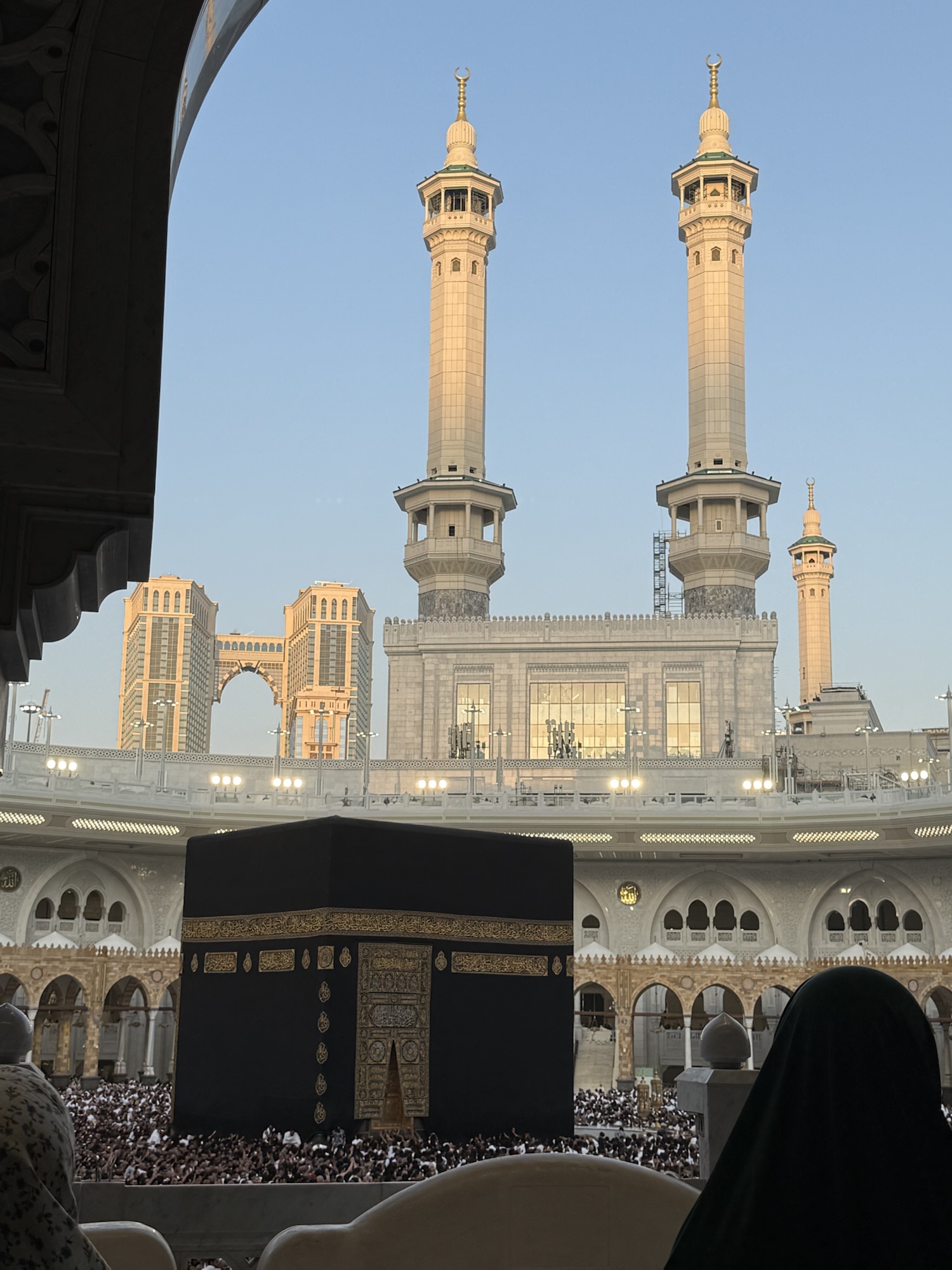
Then there is the circling of the Kaaba, known as Tawaf, where pilgrims walk seven times around the sacred cube-shaped building at the centre of the Grand Mosque in Mecca. Muslims believe the Kaaba was originally built by Abraham and his son Ishmael as a house dedicated to the worship of One God. At first glance, millions of people moving in circles may seem unusual to outsiders. Yet the symbolism is deeply powerful. Life itself moves in cycles: days and nights, seasons, birth and death. The planets orbit the sun. Atoms move in motion. Pilgrims circling together remind us that human beings are not the centre of existence. We revolve around something greater than ourselves. Rich and poor, black and white, young and old, all moving in the same direction with the same purpose. In a world increasingly shaped by individualism and ego, Tawaf is an act of humility. It asks us to stop orbiting around ourselves and instead place faith, purpose, compassion and community at the centre of our lives.
Another ritual of Hajj involves pilgrims symbolically throwing stones at pillars representing temptation and evil, recalling Abraham resisting Satan’s attempts to turn him away from obedience and compassion.
Again, the symbolism feels deeply relevant.
We may not face devils in physical form, but every day we confront temptations: anger, prejudice, greed, pride, gossip, fear and division.
The ritual asks a difficult question:
What do you need to reject in order to become a better human being?
And then there is sacrifice itself, remembered through Eid al-Adha tomorrow. Abraham’s willingness to sacrifice what he loved most, before God provided another way, reminds believers that faith is not blind ritual. It is about values.
What are we willing to give up for what is right?
Our ego?
Our resentment?
Our selfishness?
Our prejudices?
At its best, Hajj reminds humanity of something deeply important: faith should move us towards humility, compassion and service to others.
The Day of Arafat is often described as a day of mercy, a day when prayers are answered and forgiveness is abundant. Even Muslims not on pilgrimage often fast today, pray more deeply and spend time reflecting on their lives.
Because ultimately, Arafat is not only about a mountain in Saudi Arabia.
It is about standing still long enough to ask ourselves:
Who am I becoming?
What really matters?
What burdens do I need to let go of?
And what kind of world do I want to help build?
Tomorrow is Eid.
Families will gather. Homes will fill with laughter, food and celebration. Messages of “Eid Mubarak” will travel across continents.
But perhaps before the celebration begins, there is something beautiful in pausing to remember the stories that brought us here.
A Prophet prepared to sacrifice.
A family sustained through faith.
And a mother whose desperate search for water became a sacred act remembered by millions for generations.
In remembering Hagar, perhaps we also remember something about ourselves:
Sometimes faith is simply continuing to walk between the hills, trusting that somewhere, somehow, water will come.
Eid Mubarak for tomorrow to all who are celebrating. And for those not celebrating, perhaps this is a moment to reflect on the shared human stories that connect us all.
 Soulful Spaces